Anúncios
Impact of Robotics and AI on Job Displacement
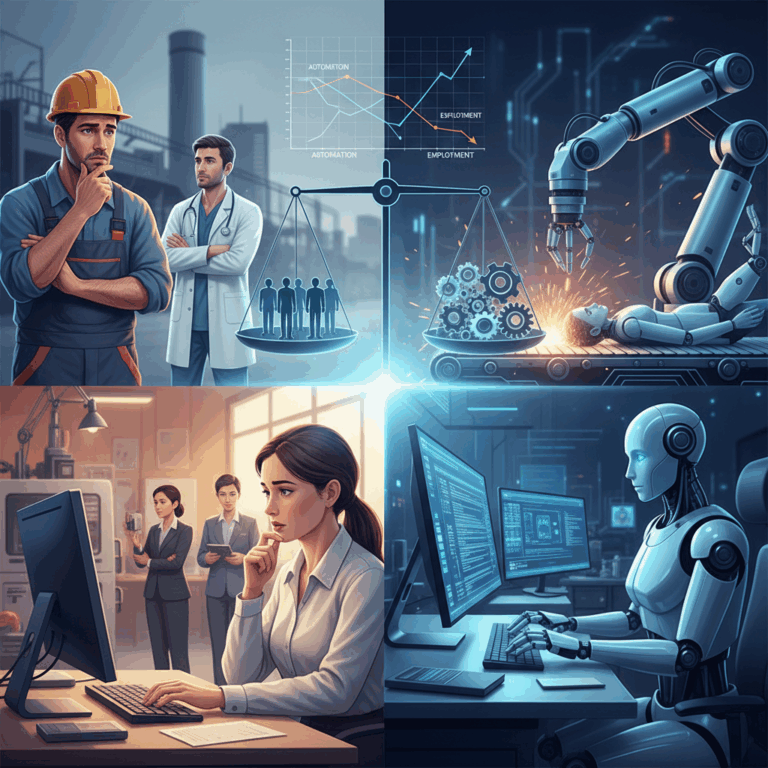
The rapid advancement of robotics and artificial intelligence (AI) is significantly influencing the global workforce. While automation raises concerns about job losses, its effects are varied across industries.
Automation impacts depend heavily on the type of work and region. Some jobs face a higher risk of displacement, especially those with routine tasks, while others remain more secure due to skill requirements.
Anúncios
Global Job Displacement Estimates and Industry Variation
Estimates suggest that up to 300 million jobs worldwide could be displaced by AI and robotics by 2030. This requires about 14% of workers globally to shift occupations due to automation.
The risk of displacement varies greatly by industry. Roles involving repetitive tasks are highly vulnerable, while jobs demanding creativity or social intelligence face less threat from automation.
Anúncios
Manufacturing, especially sectors like automotive production, experiences significant automation, reflecting the uneven impact across economic fields. This leads to job loss in some areas but growth in others.
Regional and Economic Differences in Automation Risk
Advanced economies see a greater share of jobs at risk, with around 60% vulnerable to automation, contrasting with only 26% in low-income countries. These differences reflect economic and technological disparities.
Regions with heavy industrial bases, such as the U.S. Rust Belt, experience sharper effects as automation adoption rises. This results in localized wage declines and employment shifts, deepening economic divides.
Nonetheless, automation’s impact depends on regional policies and labor market flexibility, which can either mitigate or amplify displacement risks across diverse economic settings.
Economic and Labor Market Effects of Automation
Automation has a complex impact on economies and labor markets. It can displace some jobs while simultaneously enhancing productivity and creating new opportunities.
The balance between job loss and job creation is influenced by technology adoption rates, industry type, and the ability of workers to adapt through reskilling and education.
Case Study: Robots in Manufacturing and Local Employment
Introducing robots in manufacturing has shown measurable effects on employment. In the U.S., one additional robot per 1,000 workers reduces local employment by 0.2 percentage points.
Wages in highly automated regions also tend to decline slightly, highlighting economic pressures in communities dependent on routine manufacturing roles vulnerable to automation.
These impacts are most notable in industries like automotive production and regions such as the Rust Belt, where automation adoption is widespread and transformation is intense.
Automation’s Effect on Productivity and Job Outsourcing
While automation can reduce certain jobs, it boosts productivity, helping companies become more competitive in global markets. This productivity gain may help retain or even return jobs previously outsourced.
Automation facilitates higher efficiency, enabling firms to innovate and improve quality, which can lead to demand growth and potentially create new employment opportunities over time.
The interplay between automation-driven productivity and outsourcing trends varies by sector, influencing labor markets differently depending on business strategies and technology use.
Contrasting Predictions and Actual Employment Trends
Despite forecasts of widespread job displacement, recent data shows that many businesses have not significantly reduced workforce sizes after adopting AI and robotics.
New roles in areas like data science and AI ethics are emerging, offsetting job losses in more routine positions. This suggests a more dynamic labor market adapting to automation.
Economic research indicates that temporary unemployment spikes may give way to long-term job growth as economies adjust and workers acquire new skills for evolving roles.
Emerging Roles and Workforce Adaptation
The rise of AI and robotics does not only bring displacement but also creates new roles in the workforce. These technologies generate opportunities in emerging industries and occupations.
As automation evolves, workers must adapt by acquiring new skills and embracing changing job functions. This transition shapes a dynamic labor market with shifting demands.
New Job Creation through AI and Robotics
AI and robotics are expected to create millions of new jobs globally by 2030, especially in fields like data science, AI ethics, and human-machine collaboration. These roles often require advanced technical skills.
New occupations are emerging to support, maintain, and innovate AI systems, leading to growing demand for specialists who can navigate complex technologies and ethical challenges.
While some traditional jobs may disappear, the overall employment landscape expands as automation drives innovation, prompting new industries and career paths.
Technology Augmentation and Changing Nature of Work
Rather than simply replacing jobs, AI and robotics often augment workers’ capabilities, enabling higher productivity and more value in their roles through advanced tools and automation support.
This augmentation shifts job responsibilities, requiring workers to develop complementary skills and adapt to collaborative environments with intelligent systems.
The future workforce will increasingly blend human creativity and judgment with machine efficiency, leading to evolving roles that integrate technology seamlessly into daily tasks.
Adapting to the Hybrid Workforce
Successful workforce adaptation depends on continuous learning and flexibility. Embracing lifelong education helps workers stay relevant as automation changes job content and skill requirements.
Organizations must foster environments that support tech adoption and human-machine collaboration, ensuring workers can thrive alongside evolving AI and robotic systems.
Strategies for Workforce Transition and Policy Making
Effectively managing the shift brought by automation requires focused strategies on workforce transition. Education, reskilling, and lifelong learning form the backbone of adapting to technological change.
Policymakers play a vital role by designing supportive frameworks that enable workers to thrive amid evolving job demands and prevent long-term unemployment related to automation.
Importance of Education, Reskilling, and Lifelong Learning
Education systems must evolve to prepare workers for a future with AI and robotics. Emphasis on digital skills and critical thinking is essential for workforce resilience.
Reskilling programs help displaced workers transition into emerging roles, especially in tech-driven fields like AI ethics and data science, fostering employment continuity.
Lifelong learning encourages continuous skill upgrades, allowing workers at all career stages to remain competitive and adapt to the shifting nature of work.
Policy Responses to Support Technological Workforce Changes
Governments need proactive policies that facilitate smooth labor market adjustments, including funding for training, social safety nets, and incentives for employers to invest in human capital.
Effective policy responses prioritize collaboration between public and private sectors to align skill development with industry needs and to promote inclusive growth.
Policies should also address regional disparities by tailoring support to communities most affected by automation, thereby reducing inequalities exacerbated by technological shifts.